



Booking a consultation for breast augmentation can feel like a bigger step than it actually is. Many patients hesitate because it feels like a commitment, but a consultation is purely informational. Nothing is scheduled. Nothing is decided. It is an opportunity to ask questions, get an honest assessment of your anatomy, and leave with a clearer picture of what augmentation could realistically look like for you. This post covers three things: what your surgeon evaluates during the physical exam, what you should bring, and the specific questions worth asking before you leave the room. For patients across Orange County considering their options, Dr. Roham’s Newport Beach practice is a straightforward starting point for that conversation.
Contents
- 1 Why the consultation is the most important step in your Breast Augmentation journey
- 2 What to bring to your Breast Augmentation consultation
- 3 What your surgeon evaluates during the physical examination
- 4 How implant sizing is decided: and why “just go bigger” is not a plan
- 5 Incision and placement options: what the surgeon recommends and why
- 6 Questions every patient should ask at a Breast Augmentation consultation
- 7 What happens after the consultation
- 8 FAQ
- 8.1 Do I have to commit to surgery at the consultation?
- 8.2 How long does a Breast Augmentation consultation take?
- 8.3 Is there a fee for a consultation at Dr. Roham’s practice?
- 8.4 What if I am unsure about my size going in?
- 8.5 Can I bring photos of celebrities or influencers as reference?
- 8.6 Will I be able to see what my results might look like before surgery?
- 8.7 Do I need to have a mammogram before Breast Augmentation surgery?
- 8.8 What if my surgeon recommends a lift and I only want implants?
- 8.9 Can I consult for Breast Augmentation if I am still breastfeeding?
- 9 Ready to schedule your consultation with Dr. Roham?
- 10 Sources
Why the consultation is the most important step in your Breast Augmentation journey
The consultation is where the entire surgical plan originates. It is not a sales session. A thorough consultation prevents revision surgery later by aligning what you want with what your anatomy can realistically support. Patients often arrive with a specific size in mind and leave with a more personalized plan that accounts for their chest measurements, skin quality, and natural breast tissue. That refinement is not a compromise. It is what produces results that look like they belong on your body rather than someone else’s.
The breast augmentation procedure is one of the most customizable surgeries available, but that customization has to be grounded in physical reality. The consultation is where that grounding happens.
What a consultation is and what it is not
A consultation is an evaluation and an educational session. It is not a commitment to surgery. You are under no obligation to book a procedure, and a reputable surgeon will never create pressure to do so. Consulting two or three surgeons before making a decision is entirely normal and encouraged. A surgeon who welcomes informed, prepared patients and answers questions directly and fully is demonstrating exactly the kind of practice culture you want in an operating room.
Who should be in the room with you
Bringing a trusted friend or partner to take notes is a genuinely good idea. A second set of ears in the room helps catch details you may forget later. Inspiration photos are also useful to bring. They communicate your aesthetic preferences to the surgeon in a way that words often cannot. What they cannot do is guarantee that a specific celebrity or influencer’s result is achievable on your body, since different anatomy produces different outcomes. Use them to illustrate style and proportion preferences, not as a literal target. Writing your questions down in advance is one of the simplest things you can do to get the most out of the appointment.
What to bring to your Breast Augmentation consultation
Documents and health information
Prepare a list of your current medications, including supplements such as fish oil, vitamin E, and herbal products. Bring your prior surgical history, any relevant imaging studies (mammograms if you have had one), a list of allergies, and the contact information for your primary care physician. If there is any reconstructive component to your procedure, an insurance card is worth having on hand even if coverage is unlikely.
Visual goals and measurements
Bring inspiration photos drawn from patients with a body type similar to yours where possible. Know your current bra size, and be prepared to mention any history of size fluctuation with weight changes, since this affects long-term implant behavior. If your lifestyle involves athletic training, physically demanding work, or plans for future pregnancy, note that as well. These factors influence implant type, placement, and incision site decisions.
What your surgeon evaluates during the physical examination
The physical examination is what separates a thorough consultation from a superficial one. The information gathered here drives every decision in the surgical plan: implant type, profile, size, placement angle, and incision location. None of those decisions should be made without it.
Chest wall and breast base measurements
The base width of your breast, meaning the diameter across the natural footprint of the breast tissue, is the single most constraining measurement in implant selection. Choosing an implant wider than your natural base width risks lateral displacement and an unnatural appearance. Your surgeon will also measure the sternal notch-to-nipple distance, the nipple-to-inframammary fold distance, and the chest width between the breasts. These measurements determine whether submuscular placement is appropriate, how the implant will sit on your chest wall, and what size range is anatomically reasonable for your frame.
Skin quality, elasticity, and ptosis assessment
Skin quality and elasticity affect how well the tissue envelope accommodates and supports an implant over time. Your surgeon will also assess the degree of ptosis, which is the clinical term for breast drooping. A simple way to evaluate this is to note where the nipple sits relative to the inframammary fold: if it falls at or below that fold, some degree of lift may produce a better outcome alongside an implant. Patients who have significant ptosis and want only an implant without a lift will have a candid conversation about what augmentation alone can and cannot achieve in their specific case. For more on when both procedures are appropriate together, see our guide on breast lift with augmentation and our comparison of breast implants vs. breast lift.
Nipple position and areola size
Nipple position relative to the inframammary fold is a key factor in determining implant placement and surgical approach. A nipple positioned too low on the breast mound may require repositioning for the result to look proportionate, which is part of why ptosis assessment and augmentation planning happen together. Areola size can also be addressed during a lift procedure for patients who want that change. This is a clinical evaluation, not a value judgment about current anatomy.
Asymmetry evaluation
Nearly all patients have some degree of breast asymmetry, and this is entirely normal. Your surgeon will document existing differences in volume, nipple height, and breast position between the two sides before surgery. This documentation matters because pre-existing asymmetry that is not recorded can otherwise be attributed to the surgery after the fact. Implant selection can partially address asymmetry by choosing different sizes for each side, but it cannot fully eliminate natural asymmetry in all cases. Understanding this before surgery sets realistic expectations for the final result.
Implant profile and type discussion
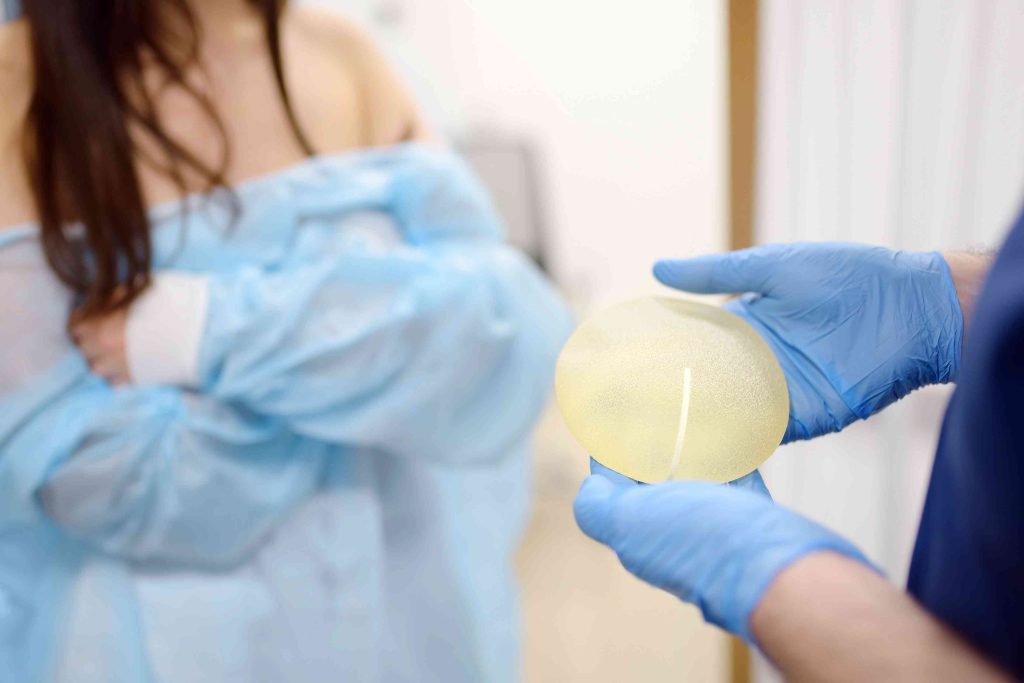
Your surgeon will walk through implant options in the context of your measurements and goals. This includes the choice between saline and silicone (for a full comparison, see our silicone breast implants guide), smooth versus textured surfaces, and round versus anatomical shapes. Profile, meaning the degree of forward projection relative to the implant’s base width, is chosen based on chest dimensions and the aesthetic goal. Low, moderate, high, and extra-high profile options allow a range of projection outcomes from the same base width. Some patients are also candidates for fat transfer breast augmentation as an alternative or complement to implants, and the consultation is the right time to ask about that option if it interests you.
How implant sizing is decided: and why “just go bigger” is not a plan
Implant sizing is an iterative process. Your measurements establish the anatomical ceiling: the maximum implant dimensions that your body can support without compromising aesthetics or safety. Within that range, your aesthetic goals guide the final selection. Tools like rice sizers or wearable implant try-ons help patients visualize proportions under clothing, though they do not perfectly replicate how an implant will look or feel after it has settled under tissue and muscle. An experienced surgeon’s judgment about how a given implant will settle in your specific anatomy is more reliable than any sizing tool alone.
One practical note: chasing a cup size is less reliable than discussing volume in cubic centimeters with your surgeon. Cup sizes vary by bra manufacturer and do not translate directly to implant specifications. Working in cc measurements gives both you and your surgeon a more precise shared language for the sizing conversation.
Incision and placement options: what the surgeon recommends and why
The three most common incision locations are the inframammary fold (placed in the breast crease, the most common and direct approach), the periareolar border (around the lower edge of the areola), and the transaxillary approach (through the armpit). Each has tradeoffs related to scar location, access, and technical complexity. The inframammary fold incision is most widely used because it provides direct access for precise pocket creation and heals reliably.
For placement, submuscular positioning (beneath the pectoralis muscle) is most commonly recommended for patients with limited natural tissue coverage, as the muscle provides additional soft tissue over the implant. Subglandular placement (above the muscle, behind the breast tissue) is appropriate for some patients and allows a somewhat faster recovery. Dual-plane placement is a hybrid technique that positions the upper portion of the implant beneath the muscle while the lower portion sits behind the breast tissue, allowing more natural settling and reduced muscle distortion with animation. Your surgeon will make a placement recommendation based on your physical evaluation. Patient preferences are part of the conversation, but the recommendation should ultimately be anatomy-driven.
Questions every patient should ask at a Breast Augmentation consultation
- Are you board-certified, and by which board? This is the most important credential question. Board certification is not a single standard. Different boards have different training requirements. Ask specifically which certifying body and verify independently. Dr. Roham is certified by the American Osteopathic Board of Surgery in Plastic and Reconstructive Surgery, which can be verified at certification.osteopathic.org.
- How many breast augmentations do you perform per year? Surgical volume correlates with technical precision. A surgeon who performs breast augmentation regularly has refined judgment that comes from pattern recognition across many cases.
- Where will surgery be performed, and what is the facility’s accreditation? Surgery should take place in an accredited surgical facility or an accredited in-office suite. Ask specifically which accreditation body (AAAASF, AAAHC, or JCAHO) and do not proceed if the facility cannot provide that answer.
- What type of anesthesia will be used, and who administers it? A dedicated anesthesia provider, either an anesthesiologist (MD or DO) or a certified registered nurse anesthetist (CRNA), should be solely responsible for your anesthesia. This is a patient safety baseline.
- Will I need a lift as well as an implant? Why or why not? If your surgeon addresses ptosis directly and explains their reasoning, that is a positive signal. If the conversation skips this entirely, ask directly.
- What implant are you recommending for me, and what is your reasoning? A surgeon should be able to explain the specific implant choice in terms of your measurements and goals, not just offer a generic preference.
- What does recovery look like, and when can I return to work and exercise? This answer should be specific to your procedure plan. Combined procedures or submuscular placement extend recovery compared to simpler cases.
- What are the most common complications, and how do you manage them? A surgeon who answers this clearly and honestly is demonstrating exactly the kind of transparency that correlates with good surgical judgment.
- What happens if I am not satisfied with the results? What does a revision involve? A confident, experienced surgeon has a clear answer to this question. Evasiveness is a warning sign.
- Can I see before-and-after photos of patients with a similar build to mine? You can review Dr. Roham’s breast augmentation before-and-after gallery before your appointment and ask to see additional relevant examples during the consultation.
What happens after the consultation
After your consultation, you will typically receive a detailed surgical quote that itemizes the components of the total cost, along with a written surgical plan outlining the recommended implant, placement, and incision approach. Most practices do not expect or pressure an immediate booking decision. Taking time to review the plan, compare notes from multiple consultations if you have had them, and ask any follow-up questions is entirely reasonable.
For context on what drives pricing in California, see our guide on breast augmentation cost in California. If cost planning is a consideration, financing options are available through Roham Plastic Surgery.
FAQ
Do I have to commit to surgery at the consultation?
No. A consultation is an information-gathering appointment, not a commitment. You should never feel pressured to book during or immediately after your first appointment.
How long does a Breast Augmentation consultation take?
Most consultations take between 45 minutes and one hour. More complex cases or patients with many questions may run longer.
Is there a fee for a consultation at Dr. Roham’s practice?
Consultation fee details are confirmed when booking. Contact the office directly for current information.
What if I am unsure about my size going in?
That is exactly what the consultation is for. Your surgeon will walk you through sizing options based on your measurements and goals. Coming in with a general sense of the aesthetic you want, even if you cannot express it in a specific cc volume, is enough to start the conversation.
Can I bring photos of celebrities or influencers as reference?
Yes, and it is helpful. Just understand that inspiration photos communicate style and proportion preferences, not achievable outcomes for every body type. Your surgeon will interpret what those photos suggest about your aesthetic goals and translate that into a plan appropriate for your anatomy.
Will I be able to see what my results might look like before surgery?
Some practices use 3D imaging or sizer systems to give patients a visual approximation. Ask specifically whether this is available during your consultation. Keep in mind that these tools provide an estimate, not a guarantee.
Do I need to have a mammogram before Breast Augmentation surgery?
Guidelines vary based on age, personal history, and family history. Your surgeon will advise you on whether pre-operative imaging is recommended in your specific case, and your primary care physician may also weigh in based on your screening history.
What if my surgeon recommends a lift and I only want implants?
This is a conversation worth having honestly. Your surgeon’s recommendation is based on your physical assessment, and understanding the reasoning helps you make an informed decision. Patients who decline a recommended lift should understand clearly how that affects the likely outcome before proceeding.
Can I consult for Breast Augmentation if I am still breastfeeding?
Most surgeons recommend waiting until breastfeeding has fully concluded and hormone levels have stabilized before scheduling a consultation for elective augmentation. This allows breast tissue to settle and produces a more accurate assessment of your baseline anatomy.
Ready to schedule your consultation with Dr. Roham?
Dr. Ali Roham completed a five-year general surgery residency at Henry Ford Health System followed by a three-year plastic surgery fellowship at Beaumont Health Systems, and is certified by the American Osteopathic Board of Surgery in Plastic and Reconstructive Surgery. His practice in Newport Beach focuses exclusively on breast and body procedures, and his credentials are fully verifiable through the AOBS at certification.osteopathic.org.
Patients across Orange County and beyond come to Dr. Roham for a consultation experience that is thorough, educational, and free of pressure. If you are ready to get specific answers about your options, schedule your breast augmentation consultation online or call (949) 269-6960.
Sources
- American Society of Plastic Surgeons, Consultation guidelines and breast augmentation patient safety resources: plasticsurgery.org
- FDA, Breast implant types, device approvals, and what patients should know before surgery: fda.gov
- American Osteopathic Board of Surgery, Certification verification: certification.osteopathic.org
- Mayo Clinic, Breast augmentation candidacy and procedure overview: mayoclinic.org
- Aesthetic Surgery Journal, Anatomical measurement protocols and implant selection methodology: aestheticsurgeryjournal.com